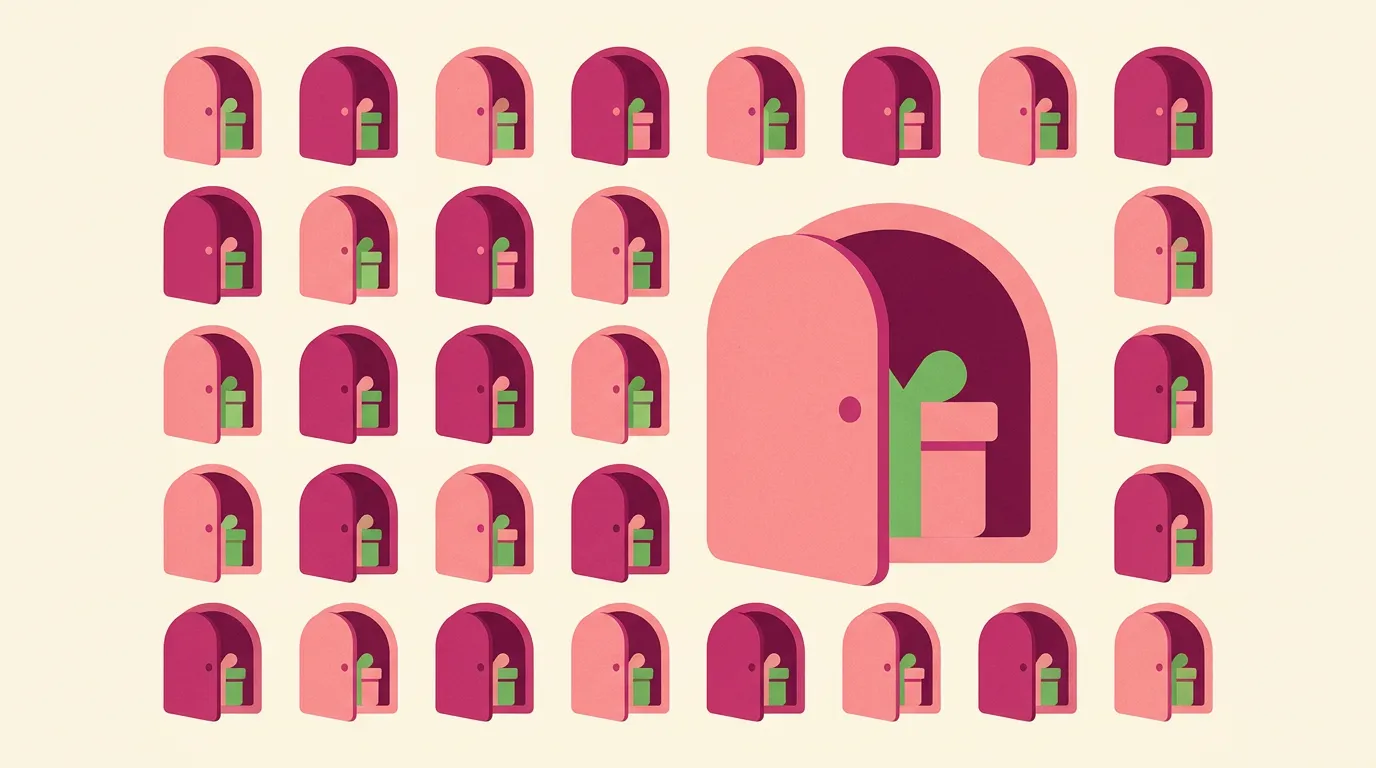
An advent calendar giveaway means one post a day from December 1 to 24, each with a small prize. It is December's most rewarding format and its most exhausting: twenty-four posts, twenty-four draws, twenty-four winners to contact. All of it is decided in November — a calendar improvised day by day is abandoned around the 9th, and an abandoned calendar is worse than none, because your audience remembers. Here is how to hold it.
Why the format works
It converts a passive audience into one that comes back every morning.
That is its real value, and it has nothing to do with the prizes. A normal giveaway produces a spike of attention on one post; an advent calendar produces a habit. Followers get into the routine of opening your account each morning, and Instagram registers those repeat visits: your organic reach climbs across the whole month and does not immediately fall back in January.
The second effect is commercial. Twenty-four posts is twenty-four chances to show a different product, at the time of year when people are buying. The calendar is a catalogue wearing a game's clothes.
The real cost: twenty-four small prizes and roughly a day of preparation in late November. That is markedly less than most businesses assume.
The November work that decides everything
Ready by November 28. No exceptions.
This is the only advice on this page that really matters. The checklist:
- The 24 prizes, bought or reserved, physically in your possession.
- The 24 visuals, shot in one session. A single template with the day number changing is enough — consistency beats variety and cuts production time by two thirds.
- The 24 captions, written and saved as drafts.
- One set of rules covering all twenty-four days, with each prize and date listed.
- The 24 posts scheduled, at a fixed hour.
The item most often forgotten is packaging and postage. Twenty-four winners means twenty-four parcels. Prepare the envelopes in November, and plan a grouped dispatch rather than a daily trip to the post office.
The test: on November 28 you should be able to leave for a week without the account stopping.
Enough reading. Run your draw.
The Lukky app is approved by Meta and connects to your account through the official APIs. Try it for free.
The mechanic for a single door
One comment, one condition, and the draw the next morning.
Friction has to be minimal, because you are asking the same person to enter twenty-four times. Any extra condition — tag a friend, post a story — wears out within three days and participation collapses from around December 5.
The format that lasts:
- Post at a fixed hour, in the morning. Eight or nine, every day, without exception: the hour is what creates the habit.
- A short question, different each day, answered in the comments.
- Close at 8pm the same day.
- Draw the next morning, and announce it in that day's post.
That last trick is what makes the format survivable: yesterday's winner is announced inside today's door, which saves you twenty-four extra posts and gives people a reason to come back.
What goes behind the doors
A progression, not twenty-four equivalent prizes.
A flat calendar runs out of steam around the 12th. The distribution that holds:
- Days 1 to 12 — small prizes. An entry product, a sample, an accessory. Low unit value, high participation.
- Days 13 to 20 — mid-range. A full product, store credit. This is the flat stretch, and the prizes have to carry it.
- Days 21 to 23 — the big ones. The full hamper, an experience, a service.
- Day 24 — the exceptional prize, announced from December 1. It is what keeps people to the end.
Two useful variants. The double day: one door at random gives two winners, announced that morning, which relaunches attention. And the partner door: a complementary brand provides the day's prize and posts it on their side, bringing you their audience at no cost.
Twenty-four draws without losing your morning
Automate the draw, and fix the deduplication once.
This is the practical point that decides whether you reach the 24th. Twenty-four manual counts add up to several hours, and the error rate climbs with fatigue — a mis-drawn winner announced publicly costs far more than the prize. An automated draw takes about thirty seconds a door: import, deduplicate, draw, capture.
Three settings to decide before December 1, and to write into the rules:
- One entry per person per day. Otherwise an account commenting fifteen times monopolises the door.
- One win per person across the whole calendar, or not. Both defensible, but decide beforehand rather than on December 14 when someone wins a fourth time.
- A short claim window — twenty-four hours. Otherwise unclaimed prizes accumulate until the 24th.
At Lukky, more than 1.7 million draws have been run from the app, and December is by far the busiest month; advent calendars account for much of it. Record each draw — fifteen seconds a day, posted to a story — and the fairness question never arises. How to pick a winner nobody disputes covers the method.
Do you actually need twenty-four days?
No, and twelve is usually the right first year.
December 13 to 24 halves the workload, covers the period when attention is highest, and lets you learn the format without risking abandonment halfway. A calendar dropped on December 9 is markedly worse than no calendar — your audience remembers it the following year.
Other workable shapes: weekends only (eight doors), or every other day (twelve doors across the month). The number is not the principle; the regularity is. Same hour, same format, no exceptions. If a full daily series is more than you want, the twelve days of giveaways format is lighter still, and a straight Christmas giveaway lighter again.
The four ways it falls apart
All four are fixed in November.
1. Starting without all 24 prizes. The fatal one. Around the 12th you improvise, quality drops, and it shows.
2. Posting at different times. The habit is the entire point of the format. A door at 8am on Monday and 3pm on Tuesday creates no reflex at all.
3. Stacking entry conditions. One comment, nothing else. You are asking the same person to come back twenty-four times.
4. Not planning for silence. Out of twenty-four winners, three or four will never reply. Without a redraw clause you end up with orphaned prizes and doors that never closed.
FAQ
Can I run an advent calendar in stories rather than posts? Stories expire in twenty-four hours and their replies are private, so the draw is unverifiable. Use stories to remind people of the day's door, and posts for the entries.
What budget should I plan? Twenty-four prizes at your cost price, plus postage. For most businesses that is less than a week of December advertising.
How do I announce winners without twenty-four extra posts? Announce yesterday's winner inside today's door.
Does the format tire an audience? It tires the part that is not playing and builds loyalty in the part that is. Expect some unfollowing early in the month, amply repaid later.
What if I am starting too late? After December 1, do not launch a calendar. Run a straight Christmas giveaway or a short format instead.
Can prizes be digital? Yes — store credit, exclusive content, early access to the January sale. No logistics at all, and the format suits it well.
Lukky draws from the comments on an Instagram or Facebook post in seconds, removes duplicates, and produces a certified result — twenty-four times if that is what the month needs. See how it works.